Battery Energy Storage Market - Challenges & Opportunities
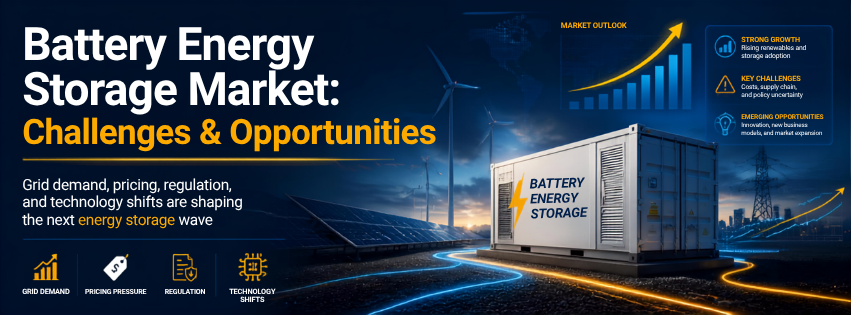
The global transition toward clean energy has transformed Battery Energy Storage Systems (BESS) from a niche technology into a cornerstone of modern power grids. Driven by the rapid expansion of variable renewable energy sources like solar and wind, energy storage is essential for bridging the gap between intermittent generation and fluctuating electricity demand.
While the BESS market is expanding rapidly, its path forward involves a complex interplay of high-growth opportunities and persistent operational hurdles.
Key Market Drivers & Opportunities
▪ Grid Stabilization & Arbitrage: BESS enables utilities and power producers to store low-cost excess electricity during peak solar or wind production and discharge it during high-demand evening hours (load shifting and peak shaving). It also provides high-value ancillary services like frequency regulation and voltage support to ensure power quality.
▪ Transition from Net Metering to Net Billing: In many regional markets, regulatory shifts away from favorable net metering rates toward net billing structures are incentivizing residential and commercial consumers to add behind-the-meter storage. Batteries allow consumers to maximize self-consumption of rooftop solar generation rather than selling power back to the grid at reduced wholesale rates.
▪ Support for EV Expansion & AI Infrastructure: The convergence of electric vehicle (EV) fast-charging hubs and power-dense data centers (amplified by AI workloads) is creating localized demand spikes. On-site battery storage acts as a buffer, enabling rapid high-power charging without overloading localized transformers or requiring expensive grid upgrades.
▪ Diversification of Battery Chemistries: While Lithium Iron Phosphate (LFP) and Lithium Nickel Manganese Cobalt (NMC) dominate current utility and commercial deployments, alternative technologies are scaling. Sodium-ion batteries are emerging as a cost-effective alternative for stationary storage, reducing supply chain dependency on lithium and cobalt.
Critical Market Challenges
▪ Thermal Management & Fire Safety: Thermal runaway remains one of the primary technical and public safety risks associated with high-energy-density battery installations. Ensuring long-term thermal stability requires advanced Liquid Cooling Systems and robust Ingress Protection (e.g., IP65/IP66 ratings) to operate reliably in high ambient temperatures and dusty environments.
▪ High Initial Capital Expenditure (CapEx): Despite long-term cost declines, the upfront investment for long-duration, high-cycle battery systems, power conversion systems (inverters), and structural infrastructure remains a key barrier for commercial and industrial adoption.
▪ Supply Chain Concentration: A significant portion of raw material refining and battery cell manufacturing remains concentrated in single regions, leaving global supply chains vulnerable to geopolitical tensions, trade tariffs, and price volatility.
▪ Degradation & Lifecycle Management: Cell performance degrades over thousands of charge-discharge cycles due to chemical breakdown and thermal stress. Implementing effective recycling frameworks and second-life applications for retired cells is crucial to mitigating environmental impact and recovering critical minerals.
Strategic Outlook & Conclusion
The future of the battery energy storage market relies on balancing technical innovation with regulatory modernization. As safety standards tighten and manufacturing costs continue to adjust, BESS will play an indispensable role in maintaining a resilient, flexible, and sustainable energy landscape.