
Industry Insights
News & Updates
Stay up to date with the latest from Pakistan's solar industry, policy changes, and technological breakthroughs.

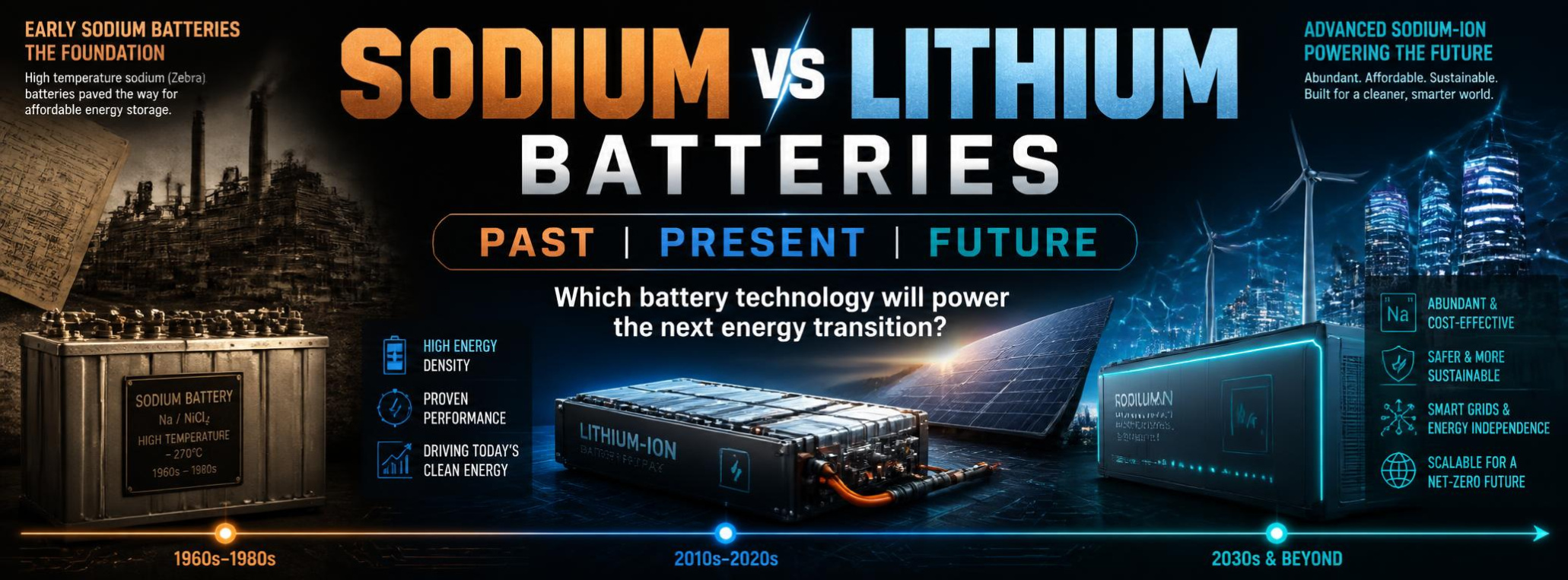
Sodium VS Lithium Batteries | Past | Present and future
For fifteen years, “battery” has been shorthand for lithium-ion. But a second chemistry — built on one of the most abundant elements on Earth — is now shipping in real vehicles and real storage cabinets. Here’s how sodium-ion got here, where it stands today, and what it means for the batteries behind solar systems in Pakistan and everywhere else. **The Past: A 1980s Idea That Lost the First Round** Sodium-ion and lithium-ion research actually started on parallel tracks, with early sodium battery chemistry explored in laboratories back in the 1970s and 1980s ("Beyond Lithium Newsletter" https://christopherchico.substack.com/p/beyond-lithium-unveiling-the-promise), around the same time scientists were working out how to make lithium do the same job. But when it came to commercialization, lithium won decisively: Sony brought the first lithium-ion battery to market in 1991, and it became the chemistry of choice for the electronics boom, eventually powering the first mass-market electric vehicles in Japan in 1996 (IEA https://www.iea.org/commentaries/sodium-ion-battery-momentum-grows-but-challenges-remain). Lithium’s edge was straightforward physics — it packs more energy into less weight and volume than sodium — and that advantage was enough to sideline sodium-ion research for two decades. Sodium-ion never fully disappeared, though. Interest specifically picked up again after 2022, when a global spike in lithium carbonate prices exposed how much the entire clean-energy supply chain depended on a handful of geographically concentrated lithium and cobalt deposits ("Beyond Lithium Newsletter" https://christopherchico.substack.com/p/beyond-lithium-unveiling-the-promise). That price shock — not a single technical breakthrough — is largely what pulled sodium-ion out of the lab and into serious commercial investment. **The Present: From Lab Curiosity to Real Deployment** Sodium-ion has now crossed a threshold few expected this soon: • **First real-world deployments.** The first grid-scale battery storage system using sodium-ion cells went online in China in 2019, and the first sodium-ion-powered electric car reached Chinese roads in late 2023 (IEA https://www.iea.org/commentaries/sodium-ion-battery-momentum-grows-but-challenges-remain). By 2026, the first mass-production passenger EVs built around sodium-ion packs — including a Changan model with a roughly 400 km range — began reaching buyers ("Eleport" http://eleport.com/sodium-ion-vs-lithium-ion/). • **CATL’s Naxtra platform.** The world’s largest battery maker unveiled its Naxtra sodium-ion brand in April 2025 and moved it into mass production through 2026, describing it as a shift “from laboratory breakthrough to large-scale manufacturing” ("Electrek" https://electrek.co/2026/04/22/catl-launching-sodium-ion-batteries-evs-2026/). Naxtra cells reach roughly 175 Wh/kg of energy density — closing most of the historical gap with lithium iron phosphate (LFP), which typically runs 160–205 Wh/kg ("DataDeep" https://datadeep.tech/sodium-ion-batteries-2026/) — and the pack reportedly retains around 90% of usable capacity at –40°C, a genuine advantage in cold climates ("Electrek" https://electrek.co/2026/04/22/catl-launching-sodium-ion-batteries-evs-2026/). • **BYD’s parallel bet.** BYD has broken ground on a 30 GWh-per-year sodium-ion plant and developed a third-generation cell rated for more than 10,000 charge cycles, aiming initially at smaller vehicles, scooters, and low-cost mobility rather than long-range passenger cars ("Eleport" https://eleport.com/sodium-ion-vs-lithium-ion/). • **Cost is close, not settled.** This is the one area where sources genuinely disagree, which is worth being upfront about. Some 2026 industry estimates put sodium-ion cells at roughly $50–56/kWh — arguably at or below LFP’s ~$52–55/kWh ("The Cool Down" https://www.thecooldown.com/green-tech/sodium-ion-batteries-energy-density-pricing/). Other detailed techno-economic breakdowns put sodium-ion cells meaningfully higher, in the $190–240/kWh range depending on cathode chemistry, against LFP nearer $60–75/kWh, with sodium-ion cell costs falling roughly 24% year-over-year through 2025–2026 ("Zhuowei New Energy" https://www.zvepow.com/new/sodium-Ion-battery-cost-per-kwh-in-2026). The honest summary: sodium-ion is closing in on cost parity with LFP and may already beat it in specific cell formats and volumes, but it has not delivered a clear, universal cost advantage yet. •** Why the interest, regardless of the price debate.** Sodium is more than a thousand times more abundant than lithium and can be extracted from ordinary salt deposits and seawater rather than a handful of concentrated mining regions (Beyond Lithium Newsletter https://christopherchico.substack.com/p/beyond-lithium-unveiling-the-promise). Sodium-ion cells also typically use no cobalt and can substitute aluminum for copper at the anode current collector (Beyond Lithium Newsletter https://christopherchico.substack.com/p/beyond-lithium-unveiling-the-promise), which helps insulate the technology from the price volatility and geopolitical concentration that have periodically rattled the lithium and cobalt markets ("GEP" https://www.gep.com/blog/strategy/lithium-ion-vs-sodium-ion-battery). • **The real trade-off.** Energy density on a per-volume basis (not just per-weight) still lags meaningfully behind lithium chemistries — by some estimates 17–49% lower — which is why sodium-ion is being positioned first for stationary storage, entry-level EVs, two- and three-wheelers, and cold-climate or industrial backup applications, rather than long-range passenger cars or aviation, where every liter of pack volume matters ("DataDeep" https://datadeep.tech/sodium-ion-batteries-2026/). **The Future: Coexistence, Not Replacement** The consensus among energy analysts — including the International Energy Agency — is that sodium-ion is best understood as a way to diversify the world’s battery supply chains, not a wholesale replacement for lithium-ion (IEA https://www.iea.org/commentaries/sodium-ion-battery-momentum-grows-but-challenges-remain). A widely cited 2025 study published in Nature Energy modeled thousands of scenarios and found that sodium-ion could become cost-competitive with low-cost lithium-ion variants sometime in the 2030s, but stressed that the timeline depends heavily on how lithium, graphite, and other critical mineral prices move in the meantime (Nature Energy https://www.nature.com/articles/s41560-024-01701-9). For now, sodium-ion’s total global production remains under 1% of lithium-ion’s (IEA https://www.iea.org/commentaries/sodium-ion-battery-momentum-grows-but-challenges-remain), so this is a story about where the next generation of capacity gets built, not an imminent changeover. Realistic near-term territory for sodium-ion includes: • **Stationary and residential battery storage** — where volume and weight matter far less than cost, cycle life, and safety, making it a natural fit for solar-plus-storage systems. • **Entry-level and urban EVs, e-bikes, and scooters** — where a shorter range is an acceptable trade for lower cost and better cold-weather performance. • **Cold-climate and industrial backup applications** — leveraging sodium-ion’s strong low-temperature performance. Even skeptics in the industry now generally agree sodium-ion has moved past the “will it ever work” question. Battery researcher Shirley Meng of the University of Chicago has said real-world deployment data from the batteries now shipping will accelerate further improvement, and expects sodium-ion to match today’s best lithium-ion performance within a decade (Physics APS). **What This Means for Solar & Storage Buyers** The practical takeaway for anyone weighing a battery storage investment today isn’t “wait for sodium-ion” — lithium iron phosphate remains the safer, more proven, more energy-dense choice for space-constrained residential and commercial installations right now. But it is worth watching closely over the next two to three years, particularly for larger stationary storage projects where sodium-ion’s lower material-cost ceiling and strong cycle life could start showing up in genuinely competitive pricing.
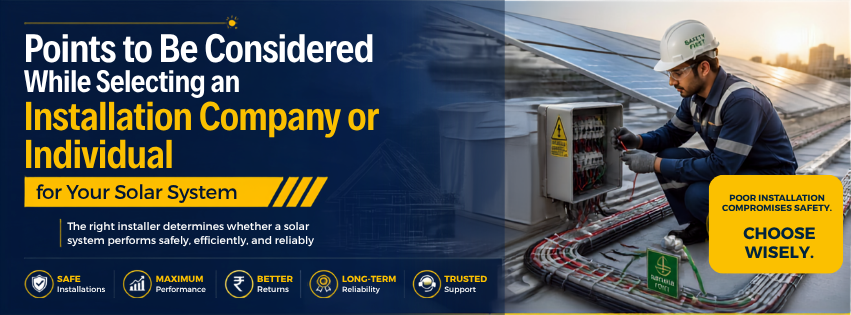
Choosing the right Installer or Company
**Points to Be Considered While Selecting an Installation Company or Individual for Your Solar System** The best solar panels and batteries in the world will still underperform — or fail outright — if installed incorrectly. Wiring mistakes, poor earthing, wrong angles, and mismatched components are among the most common reasons a solar system doesn't deliver its promised output. Choosing the right installer matters as much as choosing the right equipment. Here's what to actually check. **1. Licensing and certification** In Pakistan, look for installers holding an AEDB (Alternative Energy Development Board) licence and, where relevant, a PEC (Pakistan Engineering Council) registration. These aren't just paperwork — they're a baseline signal that the installer has met a minimum standard of technical competence and accountability. **2. Manufacturer-specific training** A general electrician is not the same as someone trained specifically on the panels, inverter, and battery brands going into your system. Ask whether the installer has received direct training from the brands they're installing — reputable brands run installer training programs precisely because incorrect installation is one of the most common causes of underperformance and warranty disputes. **3. A verifiable track record — not just claims** Ask to see actual completed projects: photos, video walkthroughs, addresses (with permission), or direct references from past customers. An installer confident in their work will have no hesitation showing you real, verifiable examples rather than stock imagery or vague testimonials. **4. Independent verification — not just self-reported reviews** Self-published reviews on an installer's own website or Facebook page are easy to curate. Look for installers whose credentials, site work, and customer feedback have been independently verified by a third party — through an actual site visit audit, not just a form they filled out themselves. **5. Team size and after-sales capacity** A one-person operation might be perfectly competent for the installation itself, but ask directly: who handles a fault call six months from now? What does after-sales support actually look like — team size, response time, and whether they offer any ongoing monitoring or maintenance service, not just a one-time install and disappear. **6. A proper site survey before quoting** Be cautious of any installer who provides a firm quote without visiting your site first. A proper installer should assess your roof structure, shading, panel orientation, existing electrical setup, and daytime load pattern before recommending a system size — especially now that net billing makes correct system sizing (for self-consumption, not just export) far more important than it used to be. **7. Transparency on what's included — and what isn't** Get a clear, itemized breakdown covering panels, inverter, battery (if applicable), mounting structure, breakers, cabling, earthing, lightning arrestors, and labour. Ask explicitly what happens if something needs replacing under warranty — is that visit free, or billed separately? Vague or verbal-only quotes are a common source of disputes later. **8. Willingness to explain, not just sell** A good installer will walk you through *why* they're recommending a particular system size, panel type, or battery brand for your specific situation — not just push whatever earns them the highest margin. If every question gets a generic sales answer rather than a specific technical explanation, that's worth noting. **The Crux** The panel and battery brand you choose only delivers its rated performance if it's installed correctly, wired safely, and sized to your actual usage. A verified, trained, and transparent installer is not an added expense — it's what determines whether the rest of your investment actually pays off. **Notes on sourcing** This article reflects general solar installation best practices widely documented across the industry — installer licensing requirements, manufacturer training programs, and system-sizing principles are standard guidance recommended by solar associations and equipment manufacturers globally. Specific licensing bodies referenced (AEDB, PEC) are Pakistan's recognized regulatory and professional bodies for the sector.
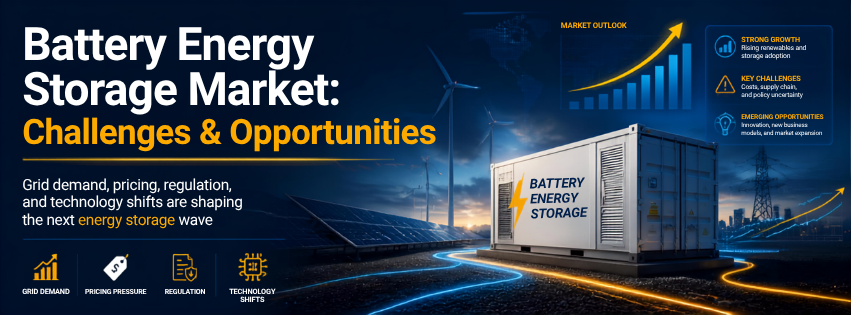
Battery Energy Storage Market - Challenges & Opportunities
The global transition toward clean energy has transformed Battery Energy Storage Systems (BESS) from a niche technology into a cornerstone of modern power grids. Driven by the rapid expansion of variable renewable energy sources like solar and wind, energy storage is essential for bridging the gap between intermittent generation and fluctuating electricity demand. While the BESS market is expanding rapidly, its path forward involves a complex interplay of high-growth opportunities and persistent operational hurdles. **Key Market Drivers & Opportunities** **▪ Grid Stabilization & Arbitrage:** BESS enables utilities and power producers to store low-cost excess electricity during peak solar or wind production and discharge it during high-demand evening hours (load shifting and peak shaving). It also provides high-value ancillary services like frequency regulation and voltage support to ensure power quality. **▪ Transition from Net Metering to Net Billing:** In many regional markets, regulatory shifts away from favorable net metering rates toward net billing structures are incentivizing residential and commercial consumers to add behind-the-meter storage. Batteries allow consumers to maximize self-consumption of rooftop solar generation rather than selling power back to the grid at reduced wholesale rates. **▪ Support for EV Expansion & AI Infrastructure:** The convergence of electric vehicle (EV) fast-charging hubs and power-dense data centers (amplified by AI workloads) is creating localized demand spikes. On-site battery storage acts as a buffer, enabling rapid high-power charging without overloading localized transformers or requiring expensive grid upgrades. **▪ Diversification of Battery Chemistries:** While Lithium Iron Phosphate (LFP) and Lithium Nickel Manganese Cobalt (NMC) dominate current utility and commercial deployments, alternative technologies are scaling. Sodium-ion batteries are emerging as a cost-effective alternative for stationary storage, reducing supply chain dependency on lithium and cobalt. **Critical Market Challenges** **▪ Thermal Management & Fire Safety:** Thermal runaway remains one of the primary technical and public safety risks associated with high-energy-density battery installations. Ensuring long-term thermal stability requires advanced Liquid Cooling Systems and robust Ingress Protection (e.g., IP65/IP66 ratings) to operate reliably in high ambient temperatures and dusty environments. **▪ High Initial Capital Expenditure (CapEx):** Despite long-term cost declines, the upfront investment for long-duration, high-cycle battery systems, power conversion systems (inverters), and structural infrastructure remains a key barrier for commercial and industrial adoption. **▪ Supply Chain Concentration:** A significant portion of raw material refining and battery cell manufacturing remains concentrated in single regions, leaving global supply chains vulnerable to geopolitical tensions, trade tariffs, and price volatility. **▪ Degradation & Lifecycle Management:** Cell performance degrades over thousands of charge-discharge cycles due to chemical breakdown and thermal stress. Implementing effective recycling frameworks and second-life applications for retired cells is crucial to mitigating environmental impact and recovering critical minerals. **Strategic Outlook & Conclusion** The future of the battery energy storage market relies on balancing technical innovation with regulatory modernization. As safety standards tighten and manufacturing costs continue to adjust, BESS will play an indispensable role in maintaining a resilient, flexible, and sustainable energy landscape.
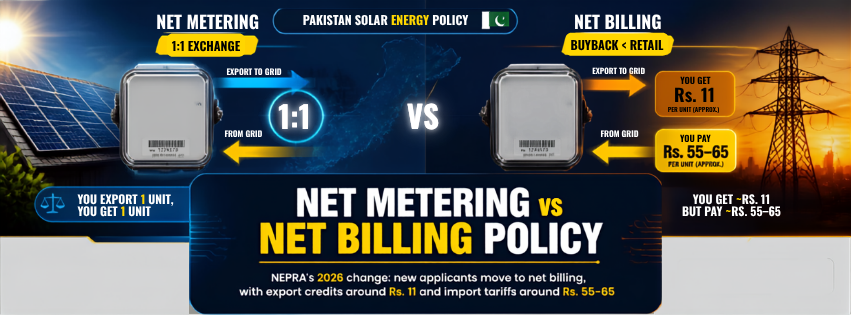
Net Metering vs Net Billing in Pakistan
**What Changed and What It Means for You** For nearly a decade, Pakistan's rooftop solar boom ran on a simple deal: whatever electricity you sent to the grid was worth exactly what you paid to take it back. That deal changed in February 2026, and it's the single biggest shift in the economics of going solar in Pakistan since the original 2015 net metering framework was introduced. **What net metering was** Under the Net Metering Regulations 2015, a solar consumer’s bi-directional meter effectively allowed exported electricity to offset imported electricity. When a solar system generated more electricity than the household consumed, the surplus was exported to the grid. At the end of the billing cycle, off-peak exported units were credited at the same rate as off-peak imported units. For example, if a consumer exported 200 off-peak units and consumed 300 off-peak units, they would only be billed for the net 100 units. However, peak-hour consumption could not be directly neutralized on a 1:1 basis. To offset peak-hour consumption, consumers needed to generate and export surplus electricity during off-peak hours. These excess exports were converted into credits after a three-month settlement period, and the accumulated credit could then be adjusted against peak-hour charges. This mechanism allowed some net-metered consumers to reduce their bills substantially, in certain cases even resulting in negative bills. This 1:1 net-metering mechanism also made oversized solar systems financially attractive. Consumers could install more solar capacity than their actual daytime requirements, export the surplus to the grid, and use the resulting credits to offset electricity consumption at the prevailing retail tariff. **What changed with net billing** n February 2026, NEPRA introduced the Alternative and Renewable Energy (ARE) Prosumer Regulations 2026, replacing net metering with net billing for new applicants. The key change is simple: imported and exported electricity are no longer valued at the same rate. - **Exported electricity: **credited at a NEPRA-determined buyback rate, currently around Rs. 8 to 13/unit. - **Imported electricity:** billed at the applicable retail tariff, often around Rs. 35–65/unit for residential/Commercial consumers. This creates a significant gap around 1:5 ratio between the value of electricity exported to the grid and the cost of electricity purchased from it. **Protection for Existing Consumers** Following strong concerns from the solar industry and consumers, NEPRA clarified that consumers with net-metering agreements signed before the applicable cut-off would retain their existing 1:1 net-metering terms until their contracts expire. New applicants, however, are subject to net billing from day one. **How Is the Export Rate Determined?** The export rate is linked to the National Average Power Purchase Price (NAPPP), which is determined and notified by NEPRA. It broadly reflects the cost of power procurement, including: - Generation and energy costs - Capacity charges - Transmission and related charges - Other tariff adjustments However, NEPRA does not appear to publish a single, transparent formula that allows the NAPPP to be independently recalculated. In simple terms, the export rate is a regulatory outcome of NEPRA’s tariff-determination process, rather than a fixed formula—and therefore can change as power-purchase costs and other underlying factors change. **Why this changes how a system should be sized** Under net metering, bigger was often better — export what you didn't use and get full value back. Under net billing, that math has flipped. Because exported electricity is worth roughly a fifth of imported electricity, a system designed to maximize export no longer makes financial sense. The smarter approach now is to size a system around self-consumption: using as much of your solar generation as possible during the day, rather than sending it to the grid for a low buyback rate. This is also why battery storage has become far more relevant to a solar decision in Pakistan than it was two years ago. A battery lets you store daytime surplus and use it in the evening — when your own consumption is happening anyway — instead of exporting it at a fraction of its value and buying it back later at full price. **What this means if you're planning a system in 2026** • **Existing net metering users: **your current agreement is protected until it expires; no immediate action is required. • **New applicants**: expect net billing terms, and size your system for self-consumption rather than export. • **Battery storage:** worth serious consideration now, since it directly addresses the gap net billing created. • **Installer sizing:** a verified, experienced installer should be running your system size against your actual daytime load profile, not just your roof space. Net billing doesn't make solar a bad investment in Pakistan — it makes system design matter more than it used to. The households and businesses that get the best returns from here on will be the ones sized correctly for how they actually use electricity, not the ones simply chasing panel count. **References** 1. NEPRA Prosumer Regulations 2026
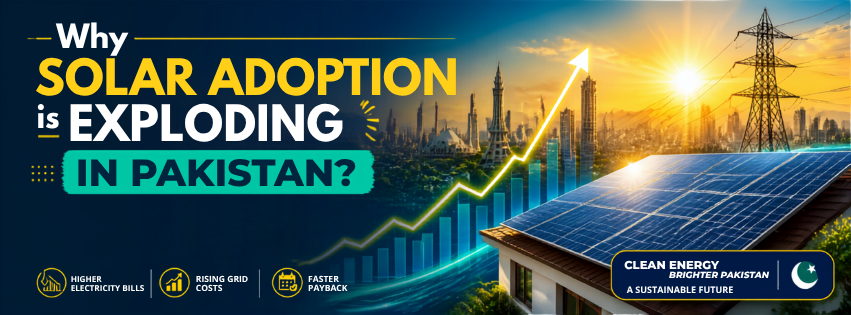
Why Solar Adoption is Exploding in Pakistan?
**Reasons Behind Rapid Solar Adoption in Pakistan** Pakistan has become one of the fastest-growing solar markets in the world — and almost none of it was planned by the government. According to the World Resources Institute, Pakistan's solar transition has been driven by a "perfect storm" of market forces rather than climate policy or industrial strategy. Between 2019 and 2025, cumulative solar panel imports surpassed the country's total installed power plant capacity, and by early 2026 solar was on track to supply roughly 20% of Pakistan's total electricity. Here's what actually drove that growth. **1. Electricity tariffs became unaffordable** The single biggest driver was cost. Grid electricity tariffs rose approximately 155% over three years, pushing many households and businesses to the point where they were paying more for electricity than for rent. High-consumption households were hit hardest under Pakistan's volume-based tariff structure, where the last units used are priced far higher than the first — making solar's payback period shrink dramatically for exactly the consumers who could afford to install it first. **2. A global glut of cheap Chinese panels** At the same time tariffs were rising, China's solar manufacturing capacity was flooding global markets with panels at historically low prices. Pakistan's government did not impose import duties on Chinese solar equipment — unlike India, which added a 40% Basic Customs Duty to protect domestic manufacturing — so Pakistani buyers got direct access to some of the cheapest panels in the world. That combination of falling equipment costs and rising grid costs is what analysts describe as the "perfect storm" behind the boom. **3. Chronic load shedding and unreliable grid supply** Even where electricity was nominally available, many communities faced more than 12 hours of daily load shedding. For businesses and households that simply needed a reliable power supply, solar (especially paired with battery storage) offered independence from a grid that couldn't be counted on in the first place. **4. Net metering turned solar into an investment, not just a cost-saver** Until the February 2026 shift to net billing, net metering let homeowners sell surplus electricity back to the grid at the same rate they paid for it — turning a rooftop solar system from a pure cost-cutting measure into an asset with a real financial return. Registered net metering connections grew from roughly 14,000 to more than 250,000 between the program's early years and 2026, with the steepest growth concentrated between 2022 and 2025. **5. Agriculture found its own reason: diesel prices** It isn't just homes and businesses. The removal of diesel subsidies pushed fuel prices up sharply, and farmers responded by converting diesel-powered tube wells and irrigation pumps to solar. Some estimates suggest half of Pakistan's tube wells could eventually make that switch, driven purely by the economics of avoiding costly imported diesel. **6. A national energy-security payoff** The scale of this shift has had effects beyond individual electricity bills. Research from Renewables First and the Centre for Research on Energy and Clean Air estimates Pakistan avoided more than $12 billion in oil and gas imports since 2020 because of distributed solar adoption — money that would otherwise have gone toward imported fuel to meet the same demand. **What's changing next** The boom has reshaped Pakistan's daily electricity demand curve, pushing peak demand later into the evening — a time solar can't directly serve. That's one reason battery storage adoption is now accelerating in parallel with solar: it's what lets households carry their daytime solar surplus into the evening hours when they actually need it most, especially now that net billing has made simply exporting that surplus far less rewarding than using it. **References** 1. "The Perfect Storm Fueling Pakistan's Solar Boom" — World Resources Institute — wri.org 2. "The solarisation of Pakistan's energy economy" — Ember — ember-energy.org 3. "Inside Pakistan's Solar Revolution: Growth, Drivers and Obstacles" — Climate Adaptation Platform — climateadaptationplatform.com 4. "Pakistan's solar boom protects economy from LNG import disruptions" — Green Central Banking — greencentralbanking.com 5. "Shedding light on Pakistan's distributed solar revolution" — TransitionZero — transitionzero.org 6. "Solar power panels boom Pakistan" — NPR — npr.org 7. "Pakistan solar boom" — Yale Environment 360 — e360.yale.edu
Stay informed.
Get weekly solar insights and policy updates directly in your inbox.
