
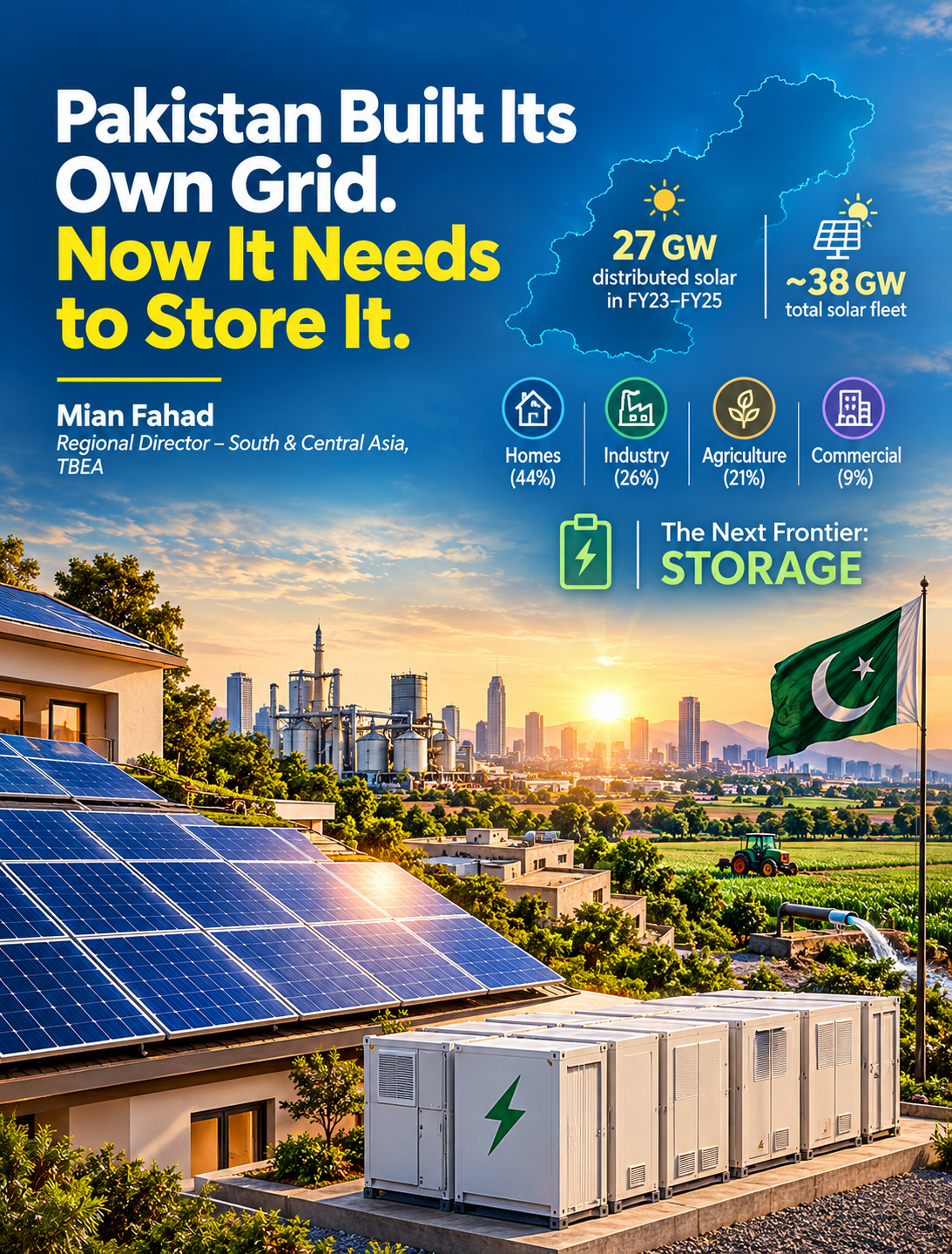
In two years, Pakistanis quietly commissioned as much generating capacity on their own rooftops as the state built in coal, gas and oil plants across its entire history. Roughly 27 GW of distributed solar went up between FY23 and FY25, taking the national fleet to about 38 GW. No tender, no sovereign guarantee, no capacity payment. Just millions of households, farmers, mill owners and shopkeepers making the same arithmetic decision at the same time.
Having spent the past decade between telecom infrastructure and renewable energy, I have watched plenty of markets move. I have not seen one move like this. And I am increasingly convinced that the official narrative still underestimates what has happened, and misreads what comes next.
The demand that the statistics missed
The conventional reading is that solar is cannibalising the grid. The numbers say something more interesting. Pakistan's total electricity demand rose about 21% between FY23 and FY25, an increase of roughly 33 TWh, while GDP grew only around 5%. Grid generation actually slipped by about 3%. Distributed solar output more than tripled, from about 15 TWh to 51 TWh, and absorbed all of that growth.
In other words, solar is not merely substituting for grid power. It is unlocking consumption that high tariffs and chronic loadshedding had suppressed for years. Distributed solar now accounts for roughly 28% of national generation, and closer to a third of delivered supply once grid losses and theft are factored in.
The second-order effect is striking. Pakistan's electrification rate, the share of final energy met by electricity, has climbed from about 17% to roughly 21.7%, almost level with the global average of 22%. We closed a gap of nearly five percentage points in two years, while the world advanced by less than one. That is not an incremental shift. It is a structural re-rating of how the economy consumes energy.
Four sectors, four different logics
What fascinates me commercially is that each segment adopted solar for an entirely different reason, which means each needs a different product and a different sales motion.
Residential (about 44% of installed capacity). Close to 7 million of Pakistan's 40 million households now own a system, averaging around 2.4 kW. Adoption skews rural, where supply was least dependable, and skews towards families able to fund the upfront cost. The use case is unambiguous: cooling. Solar and air-conditioning have become co-dependent purchases, and residential electricity demand has risen by about a third.
Industry (about 26%). Here solar is filling a vacuum rather than riding a boom. IMF-linked levies on captive gas and a steep gas price rise in late 2023 left manufacturers with three unpleasant options: pay grid tariffs, keep running expensive captive plants, or go solar. Textiles, exposed to carbon scrutiny in export markets, moved fastest. Roughly 10 GW now sits behind industrial meters.
Agriculture (about 21%). This is the most dramatic transformation of all. Solar has gone from near-zero to around 61% of the country's tubewells in three years, while diesel's share collapsed from 79% to 28%. That displaces something like 1.9 billion litres of diesel a year. The caveat is real: cheaper pumping invites groundwater over-extraction, and the industry should not pretend otherwise.
Commercial (about 9%). Small in absolute terms, yet electricity demand here grew fastest, at nearly 40%. Daytime load profiles in shops and offices align almost perfectly with solar output, so self-consumption pays without any reliance on net metering.
Why nothing else could have done this
The economic case is brutal in its simplicity. Residential solar paired with a modest battery delivers electricity at roughly PKR 20 per kWh. Grid power for commercial and higher-slab domestic users costs about PKR 40. Diesel generation runs near PKR 120. For any consumer who still fires a generator during outages, the payback is almost self-evident.
Speed matters just as much as price. Conventional projects in Pakistan have routinely taken eight, twelve, even twenty years from approval to operation. Distributed solar compressed the equivalent of the entire thermal fleet into twenty-four months, with no new transmission corridors. Because power is consumed on site, it also sidesteps the roughly 22% of grid electricity lost between generation and billing.
The macroeconomic dividend is equally material. Avoided oil and gas imports are estimated to have exceeded USD 12 billion by early 2026. For a country that spends close to a tenth of its GDP on fossil fuel imports, that is a meaningful buffer against currency shocks.
The next chapter belongs to storage
Here is where I part ways with the celebratory reading. The first wave of solar solved the daytime problem. It has also created a new one.
As rooftops saturate the midday load, the national demand curve has been pushed into the evening. During this year's fuel disruption following the Hormuz closure, loadshedding returned in precisely those evening hours, while solar quietly carried the day. The vulnerability has not disappeared. It has migrated after sunset.
Policy is compounding the shift. The move from net metering to net billing reduces the value of exporting surplus power. Regulators hope this will draw consumers back to the grid. I expect the opposite. Since most systems already sit behind the meter, the rational response for a household or factory is to keep its surplus and store it. Reduced export incentives are, in effect, a battery subsidy in disguise.
That is the inflection point I see from the field. The conversation with customers has moved from “how many panels?” to “how many hours of backup?” Hybrid inverters, lithium batteries and intelligent energy management are no longer accessories. They are becoming the core of the purchase.
Three constraints will shape how fast this happens:
• Upfront cost. Turning solar into round-the-clock supply demands more capital in batteries than in panels. Consumer financing, dealer credit and agri-lending products will decide how deep storage penetrates beyond affluent households.
• Quality and after-sales. A market built at this velocity inevitably absorbed a great deal of substandard equipment. The next buyer is more discerning, and brands that cannot service what they sell will be found out.
• Scale beyond the rooftop. Rooftop output is already around a sixth of estimated rooftop potential, and heavy industry will need more than rooftops. Grid-side and commercial-scale storage, and ground-mounted C&I projects, are the logical next frontier.
Transport sits further out. Electric two- and three-wheelers are gaining ground, and every one charged from a rooftop is electricity that national accounts will mislabel as residential or commercial. The opportunity is real even if the statistics will lag it.
A market that writes its own rules
Pakistan's solar story is often framed as a policy failure that consumers worked around. I see it differently. It is proof that when technology becomes cheap enough, demand organises itself faster than any planning ministry can.
Per-capita energy use here is still under a quarter of the global average. The growth is ahead of us, not behind. Whether that growth is electric depends on keeping power cheap, reliable and accessible, and in a post-net-metering market, reliability now has a single name: storage.
The country has already built its own power system. The next task is to make it work after dark.
