
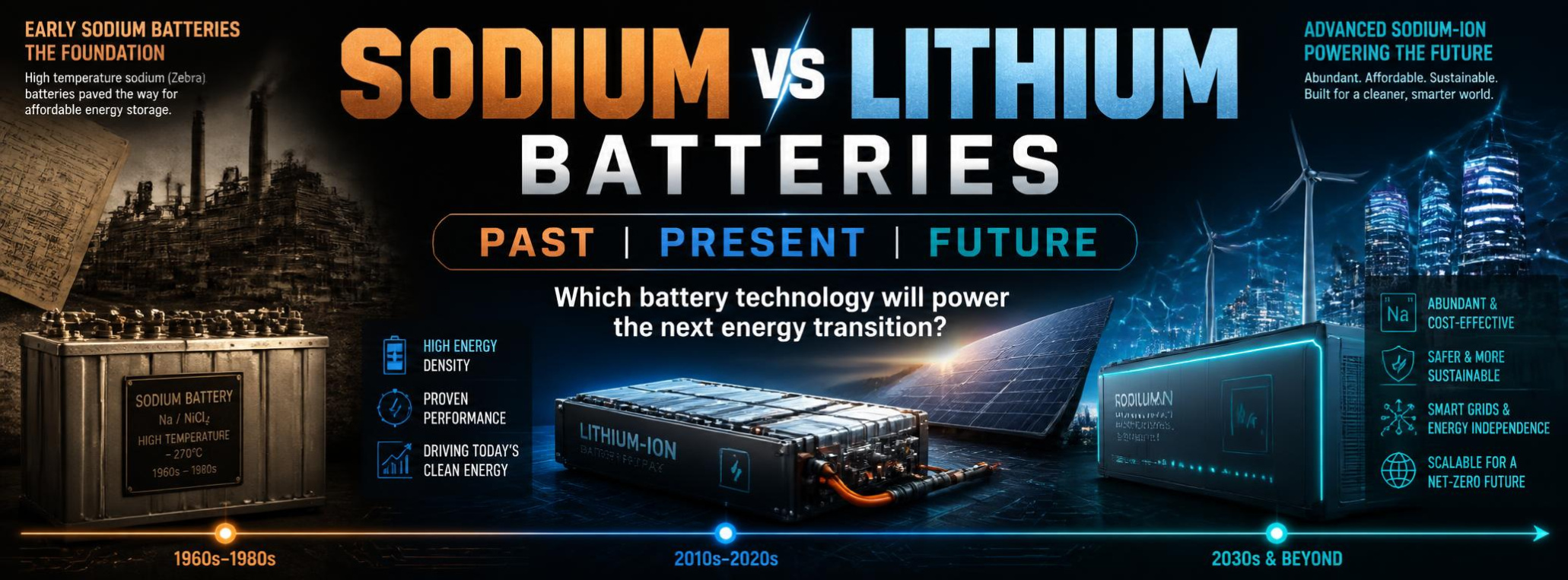
For fifteen years, “battery” has been shorthand for lithium-ion. But a second chemistry — built on one of the most abundant elements on Earth — is now shipping in real vehicles and real storage cabinets. Here’s how sodium-ion got here, where it stands today, and what it means for the batteries behind solar systems in Pakistan and everywhere else.
The Past: A 1980s Idea That Lost the First Round
Sodium-ion and lithium-ion research actually started on parallel tracks, with early sodium battery chemistry explored in laboratories back in the 1970s and 1980s ("Beyond Lithium Newsletter" https://christopherchico.substack.com/p/beyond-lithium-unveiling-the-promise), around the same time scientists were working out how to make lithium do the same job. But when it came to commercialization, lithium won decisively: Sony brought the first lithium-ion battery to market in 1991, and it became the chemistry of choice for the electronics boom, eventually powering the first mass-market electric vehicles in Japan in 1996 (IEA https://www.iea.org/commentaries/sodium-ion-battery-momentum-grows-but-challenges-remain). Lithium’s edge was straightforward physics — it packs more energy into less weight and volume than sodium — and that advantage was enough to sideline sodium-ion research for two decades.
Sodium-ion never fully disappeared, though. Interest specifically picked up again after 2022, when a global spike in lithium carbonate prices exposed how much the entire clean-energy supply chain depended on a handful of geographically concentrated lithium and cobalt deposits ("Beyond Lithium Newsletter" https://christopherchico.substack.com/p/beyond-lithium-unveiling-the-promise). That price shock — not a single technical breakthrough — is largely what pulled sodium-ion out of the lab and into serious commercial investment.
The Present: From Lab Curiosity to Real Deployment
Sodium-ion has now crossed a threshold few expected this soon:
First real-world deployments. The first grid-scale battery storage system using sodium-ion cells went online in China in 2019, and the first sodium-ion-powered electric car reached Chinese roads in late 2023 (IEA https://www.iea.org/commentaries/sodium-ion-battery-momentum-grows-but-challenges-remain). By 2026, the first mass-production passenger EVs built around sodium-ion packs — including a Changan model with a roughly 400 km range — began reaching buyers ("Eleport" http://eleport.com/sodium-ion-vs-lithium-ion/).
CATL’s Naxtra platform. The world’s largest battery maker unveiled its Naxtra sodium-ion brand in April 2025 and moved it into mass production through 2026, describing it as a shift “from laboratory breakthrough to large-scale manufacturing” ("Electrek" https://electrek.co/2026/04/22/catl-launching-sodium-ion-batteries-evs-2026/). Naxtra cells reach roughly 175 Wh/kg of energy density — closing most of the historical gap with lithium iron phosphate (LFP), which typically runs 160–205 Wh/kg ("DataDeep" https://datadeep.tech/sodium-ion-batteries-2026/) — and the pack reportedly retains around 90% of usable capacity at –40°C, a genuine advantage in cold climates ("Electrek" https://electrek.co/2026/04/22/catl-launching-sodium-ion-batteries-evs-2026/).
BYD’s parallel bet. BYD has broken ground on a 30 GWh-per-year sodium-ion plant and developed a third-generation cell rated for more than 10,000 charge cycles, aiming initially at smaller vehicles, scooters, and low-cost mobility rather than long-range passenger cars ("Eleport" https://eleport.com/sodium-ion-vs-lithium-ion/).
Cost is close, not settled. This is the one area where sources genuinely disagree, which is worth being upfront about. Some 2026 industry estimates put sodium-ion cells at roughly $50–56/kWh — arguably at or below LFP’s ~$52–55/kWh ("The Cool Down" https://www.thecooldown.com/green-tech/sodium-ion-batteries-energy-density-pricing/). Other detailed techno-economic breakdowns put sodium-ion cells meaningfully higher, in the $190–240/kWh range depending on cathode chemistry, against LFP nearer $60–75/kWh, with sodium-ion cell costs falling roughly 24% year-over-year through 2025–2026 ("Zhuowei New Energy" https://www.zvepow.com/new/sodium-Ion-battery-cost-per-kwh-in-2026). The honest summary: sodium-ion is closing in on cost parity with LFP and may already beat it in specific cell formats and volumes, but it has not delivered a clear, universal cost advantage yet.
** Why the interest, regardless of the price debate.** Sodium is more than a thousand times more abundant than lithium and can be extracted from ordinary salt deposits and seawater rather than a handful of concentrated mining regions (Beyond Lithium Newsletter https://christopherchico.substack.com/p/beyond-lithium-unveiling-the-promise). Sodium-ion cells also typically use no cobalt and can substitute aluminum for copper at the anode current collector (Beyond Lithium Newsletter https://christopherchico.substack.com/p/beyond-lithium-unveiling-the-promise), which helps insulate the technology from the price volatility and geopolitical concentration that have periodically rattled the lithium and cobalt markets ("GEP" https://www.gep.com/blog/strategy/lithium-ion-vs-sodium-ion-battery).
The real trade-off. Energy density on a per-volume basis (not just per-weight) still lags meaningfully behind lithium chemistries — by some estimates 17–49% lower — which is why sodium-ion is being positioned first for stationary storage, entry-level EVs, two- and three-wheelers, and cold-climate or industrial backup applications, rather than long-range passenger cars or aviation, where every liter of pack volume matters ("DataDeep" https://datadeep.tech/sodium-ion-batteries-2026/).
The Future: Coexistence, Not Replacement
The consensus among energy analysts — including the International Energy Agency — is that sodium-ion is best understood as a way to diversify the world’s battery supply chains, not a wholesale replacement for lithium-ion (IEA https://www.iea.org/commentaries/sodium-ion-battery-momentum-grows-but-challenges-remain). A widely cited 2025 study published in Nature Energy modeled thousands of scenarios and found that sodium-ion could become cost-competitive with low-cost lithium-ion variants sometime in the 2030s, but stressed that the timeline depends heavily on how lithium, graphite, and other critical mineral prices move in the meantime (Nature Energy https://www.nature.com/articles/s41560-024-01701-9).
For now, sodium-ion’s total global production remains under 1% of lithium-ion’s (IEA https://www.iea.org/commentaries/sodium-ion-battery-momentum-grows-but-challenges-remain), so this is a story about where the next generation of capacity gets built, not an imminent changeover. Realistic near-term territory for sodium-ion includes:
Stationary and residential battery storage — where volume and weight matter far less than cost, cycle life, and safety, making it a natural fit for solar-plus-storage systems.
Entry-level and urban EVs, e-bikes, and scooters — where a shorter range is an acceptable trade for lower cost and better cold-weather performance.
Cold-climate and industrial backup applications — leveraging sodium-ion’s strong low-temperature performance.
Even skeptics in the industry now generally agree sodium-ion has moved past the “will it ever work” question. Battery researcher Shirley Meng of the University of Chicago has said real-world deployment data from the batteries now shipping will accelerate further improvement, and expects sodium-ion to match today’s best lithium-ion performance within a decade (Physics APS).
What This Means for Solar & Storage Buyers
The practical takeaway for anyone weighing a battery storage investment today isn’t “wait for sodium-ion” — lithium iron phosphate remains the safer, more proven, more energy-dense choice for space-constrained residential and commercial installations right now. But it is worth watching closely over the next two to three years, particularly for larger stationary storage projects where sodium-ion’s lower material-cost ceiling and strong cycle life could start showing up in genuinely competitive pricing.
