
Industry Insights
News & Updates
Stay up to date with the latest from Pakistan's solar industry, policy changes, and technological breakthroughs.

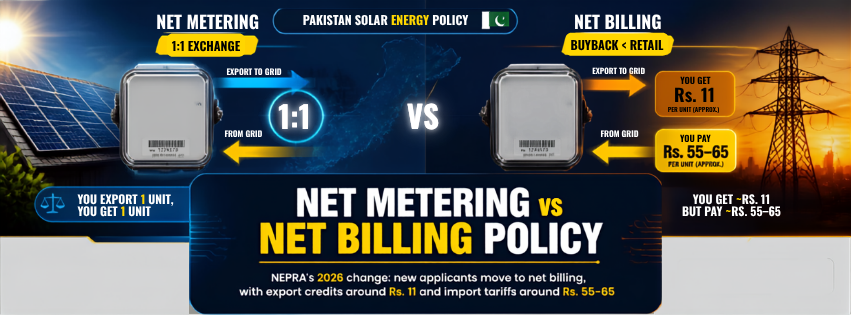
Net Metering vs Net Billing in Pakistan
**What Changed and What It Means for You** For nearly a decade, Pakistan's rooftop solar boom ran on a simple deal: whatever electricity you sent to the grid was worth exactly what you paid to take it back. That deal changed in February 2026, and it's the single biggest shift in the economics of going solar in Pakistan since the original 2015 net metering framework was introduced. **What net metering was** Under the Net Metering Regulations 2015, a solar consumer’s bi-directional meter effectively allowed exported electricity to offset imported electricity. When a solar system generated more electricity than the household consumed, the surplus was exported to the grid. At the end of the billing cycle, off-peak exported units were credited at the same rate as off-peak imported units. For example, if a consumer exported 200 off-peak units and consumed 300 off-peak units, they would only be billed for the net 100 units. However, peak-hour consumption could not be directly neutralized on a 1:1 basis. To offset peak-hour consumption, consumers needed to generate and export surplus electricity during off-peak hours. These excess exports were converted into credits after a three-month settlement period, and the accumulated credit could then be adjusted against peak-hour charges. This mechanism allowed some net-metered consumers to reduce their bills substantially, in certain cases even resulting in negative bills. This 1:1 net-metering mechanism also made oversized solar systems financially attractive. Consumers could install more solar capacity than their actual daytime requirements, export the surplus to the grid, and use the resulting credits to offset electricity consumption at the prevailing retail tariff. **What changed with net billing** n February 2026, NEPRA introduced the Alternative and Renewable Energy (ARE) Prosumer Regulations 2026, replacing net metering with net billing for new applicants. The key change is simple: imported and exported electricity are no longer valued at the same rate. - **Exported electricity: **credited at a NEPRA-determined buyback rate, currently around Rs. 8 to 13/unit. - **Imported electricity:** billed at the applicable retail tariff, often around Rs. 35–65/unit for residential/Commercial consumers. This creates a significant gap around 1:5 ratio between the value of electricity exported to the grid and the cost of electricity purchased from it. **Protection for Existing Consumers** Following strong concerns from the solar industry and consumers, NEPRA clarified that consumers with net-metering agreements signed before the applicable cut-off would retain their existing 1:1 net-metering terms until their contracts expire. New applicants, however, are subject to net billing from day one. **How Is the Export Rate Determined?** The export rate is linked to the National Average Power Purchase Price (NAPPP), which is determined and notified by NEPRA. It broadly reflects the cost of power procurement, including: - Generation and energy costs - Capacity charges - Transmission and related charges - Other tariff adjustments However, NEPRA does not appear to publish a single, transparent formula that allows the NAPPP to be independently recalculated. In simple terms, the export rate is a regulatory outcome of NEPRA’s tariff-determination process, rather than a fixed formula—and therefore can change as power-purchase costs and other underlying factors change. **Why this changes how a system should be sized** Under net metering, bigger was often better — export what you didn't use and get full value back. Under net billing, that math has flipped. Because exported electricity is worth roughly a fifth of imported electricity, a system designed to maximize export no longer makes financial sense. The smarter approach now is to size a system around self-consumption: using as much of your solar generation as possible during the day, rather than sending it to the grid for a low buyback rate. This is also why battery storage has become far more relevant to a solar decision in Pakistan than it was two years ago. A battery lets you store daytime surplus and use it in the evening — when your own consumption is happening anyway — instead of exporting it at a fraction of its value and buying it back later at full price. **What this means if you're planning a system in 2026** • **Existing net metering users: **your current agreement is protected until it expires; no immediate action is required. • **New applicants**: expect net billing terms, and size your system for self-consumption rather than export. • **Battery storage:** worth serious consideration now, since it directly addresses the gap net billing created. • **Installer sizing:** a verified, experienced installer should be running your system size against your actual daytime load profile, not just your roof space. Net billing doesn't make solar a bad investment in Pakistan — it makes system design matter more than it used to. The households and businesses that get the best returns from here on will be the ones sized correctly for how they actually use electricity, not the ones simply chasing panel count. **References** 1. NEPRA Prosumer Regulations 2026
Stay informed.
Get weekly solar insights and policy updates directly in your inbox.
